Geyserville Vineyard Acquisitions: What Buyers Should Evaluate
July 23, 2026
July 23, 2026
If you are considering a vineyard acquisition in Geyserville, the address alone does not tell the full story. In this part of Sonoma County, value and long-term utility often come down to what lies beneath the surface, what can actually be planted, and what county rules shape the land’s future use. A thoughtful review can help you move beyond the romance of Wine Country and evaluate a property with clarity. Let’s dive in.
Geyserville sits in unincorporated Sonoma County within the Alexander Valley area, near the Russian River. The landscape is deeply tied to viticulture, with vineyards shaping much of the local setting and economy.
That setting is part of the appeal, but it also means buyers need to think in county terms. Because Geyserville and Alexander Valley are unincorporated, land use, permitting, and many service questions are coordinated at the county level rather than through a city framework.
For many buyers, Alexander Valley carries real strategic and brand value. But a vineyard acquisition should never rely on a general map impression or a mailing address alone.
The Alcohol and Tobacco Tax and Trade Bureau recognizes Alexander Valley as an AVA within Sonoma County, North Coast, and Northern Sonoma. At the same time, TTB notes that map tools are informational only and that the codified boundary controls. That makes parcel-level verification an essential early step.
If AVA placement matters to your production, branding, or investment thesis, confirm exactly where the parcel sits. A property may be associated with Geyserville broadly while presenting a more nuanced AVA reality when the legal boundary is reviewed closely.
Acreage figures can be misleading when you are evaluating vineyard land. What matters is not only how large the parcel is, but how much of it is realistically plantable, accessible, and serviceable.
Sonoma County’s Vineyard Site Assessment Guide identifies slope, soils, roads, driveways, streams, riparian corridors, wet areas, and water access as core considerations. In practical terms, every one of those factors can reduce usable acreage or increase development complexity.
A beautiful rural parcel may include areas that look open but are functionally constrained. Roads, setbacks, drainage patterns, and sensitive areas can all shape what the land can support over time.
Before you get too far into pricing discussions, ask a simple question: how many acres are truly usable for vineyard purposes? That answer may differ meaningfully from the total acreage listed in marketing materials.
Steeper sections, irregular geometry, drainage issues, and riparian setbacks can limit planting plans and machinery movement. A parcel that appears generous on paper may operate much smaller in practice.
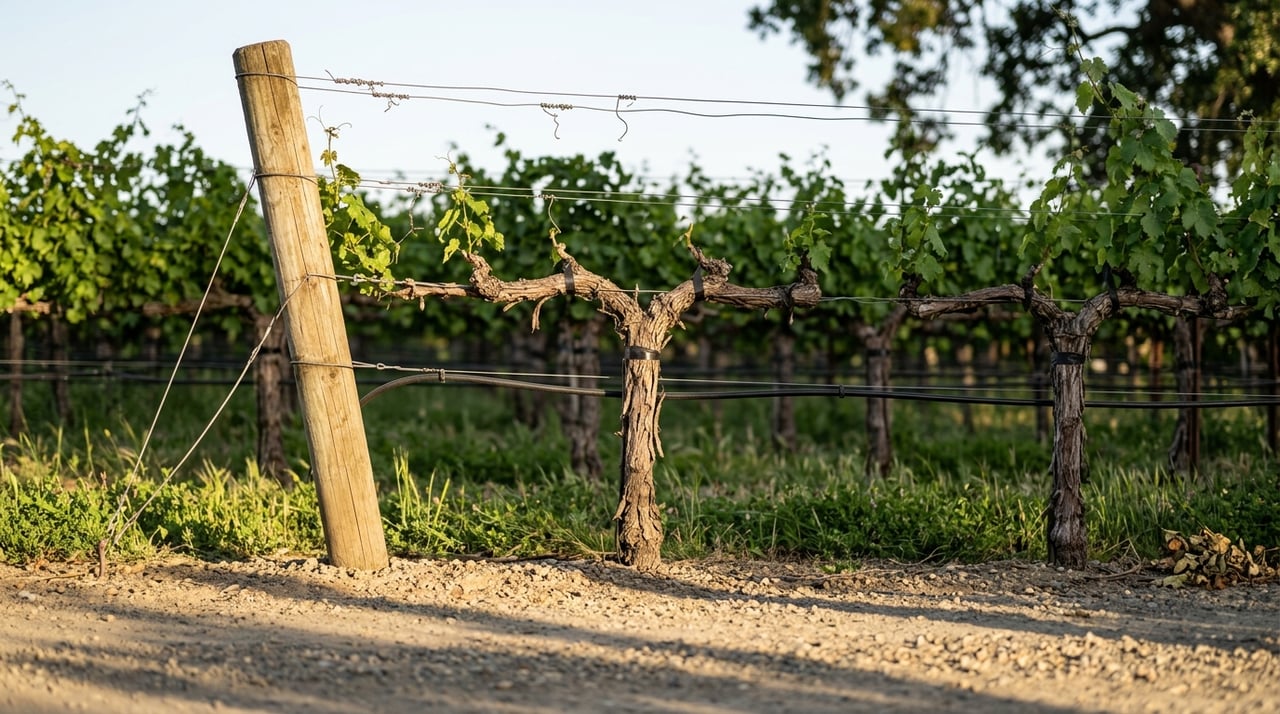
Local wine history often points to the area’s gravelly soils, but no buyer should generalize from regional reputation alone. Soil composition and drainage can vary materially from one property to the next.
UC Agriculture and Natural Resources recommends evaluating soil drainage, sunlight, slope, elevation, aspect, and site history. Those factors influence not just whether vines can be planted, but what the site can sustain over time.
Some vineyard properties are visually compelling but operationally awkward. In Geyserville, a well-composed purchase decision should balance landscape appeal with a realistic understanding of production capacity.
UCANR notes that row spacing, trellis type, irrigation needs, and varietal, rootstock, and clone choices all interact with site conditions. This means block layout is not merely a surveying detail. It is a production decision that can affect efficiency, labor, and long-term returns.
A parcel with uneven sections or constrained access may require more careful planning than its appearance suggests. As you review a candidate property, consider whether its physical layout supports your intended farming approach.
In rural acquisitions, utilities deserve early attention. Buyers should avoid broad assumptions about service availability across the 95441 area.
Sonoma Water’s Geyserville Sanitation Zone serves a limited area and has defined capacity, which suggests sewer service should be verified on a parcel-by-parcel basis. Some properties may have access to public wastewater service, while others may depend on private systems.
On the private side, Sonoma County well and septic materials show that water supply and wastewater review are detailed, site-specific matters. Plot plans, watercourses, drainage patterns, septic review, and soil or percolation analysis may all be relevant depending on the property.
These questions are easier to address during diligence than after contingencies are removed.
A vineyard purchase in Geyserville is also a rural operations decision. Beyond soils and entitlements, you should evaluate how the property functions day to day.
Northern Sonoma County Fire Protection District serves Geyserville and surrounding valley areas through multiple stations, including Geyserville and Alexander Valley. That service footprint makes fire access, driveway width, turnarounds, and defensible space practical parts of acquisition review.
The local community profile also notes no public transportation. For buyers, that reinforces the car-dependent and infrastructure-specific nature of the area. Access roads, travel times, equipment movement, and service coordination all matter.
In unincorporated Sonoma County, vineyard development and replanting are not simply private land decisions. County permitting can play a major role in what you can do and when you can do it.
Sonoma County Code Chapter 36, known as VESCO, regulates new vineyard and orchard development, replanting, and agricultural grading and drainage. Its stated goals include erosion control, watercourse protection, drainage preservation, aquatic resource protection, wildlife habitat protection, water conservation, and groundwater recharge.
This is not a minor technicality. Sonoma County’s 2024 crop report notes that the Land Stewardship Division reviewed 126 vineyard and orchard development projects in 2024. That level of review activity is a clear reminder that vineyard acquisition in this market is often permit-driven.
If your acquisition thesis depends on redevelopment, expansion, or replanting, these questions should be answered before you close.
County guidance recommends checking zoning and reviewing Recorder’s records for easements on unincorporated parcels. That is especially important for vineyard land, where access, utilities, and drainage can carry long-term operational implications.
An easement may affect where you can plant, build, access, or improve the land. Title exceptions can also shape future flexibility in ways that do not show up in a casual site visit.
This is one area where a polished property presentation should never replace documentary review. A parcel’s provenance includes its recorded constraints as much as its landscape.
A Geyserville vineyard purchase often crosses several disciplines at once. Land use, viticulture, water, access, title, and financing can all affect the final value of the asset.
Based on the county and UC due-diligence framework, buyers often benefit from involving a vineyard consultant, surveyor, civil or water engineer, environmental counsel, title and escrow professionals, and a lender comfortable with agricultural assets. The exact team will vary by parcel, but specialist input is often what turns a promising opportunity into a sound acquisition.
For many buyers, this is where experienced local guidance matters most. A disciplined process can help you assess not just whether a property is appealing, but whether it is aligned with your operational and financial goals.
The most successful vineyard acquisitions in Geyserville are rarely driven by scenery alone. They are shaped by careful parcel-level review of AVA status, plantable acreage, soils, water, wastewater, access, fire readiness, permitting, and recorded constraints.
That level of diligence does not diminish the appeal of Alexander Valley. It protects it. When you understand how a parcel functions in real terms, you can evaluate its provenance, potential, and risk with greater confidence.
If you are considering a vineyard purchase in Geyserville or anywhere in Sonoma Wine Country, Jamie Spratling offers discreet, high-touch guidance tailored to complex land and vineyard acquisitions.
Stay up to date on the latest real estate trends.